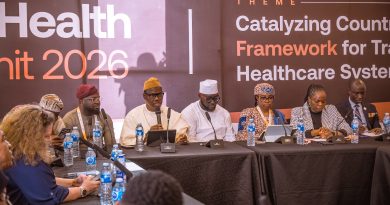

Nigeria Reports Major Health Gains as 2026 Joint Annual Review Opens in Abuja
ABUJA, Nigeria – Nigeria’s health sector reforms under President Bola Ahmed Tinubu are beginning to deliver verifiable results, with health insurance coverage expanding by nearly 8 million people and facility-based maternal deaths falling by about 60% since 2024, the Minister of State for Health and Social Welfare, Dr. Iziaq Adekunle Salako, has said.
Dr. Salako disclosed this on Tuesday, November 10, 2026, at the opening ceremony of the 2026 Nigeria Health Sector Joint Annual Review (JAR), held at the Transcorp Event Center, Maitama, Abuja.

The review, themed “Make the Data Count,” is Nigeria’s apex health sector accountability platform.
From Silos to One Promise
Addressing ministers, state commissioners, development partners, private sector actors and health workers, Dr. Salako said the JAR has become the central mechanism for measuring progress under the Health Sector Renewal Compact signed three years ago.
“Three years ago, the Health Sector Renewal Compact turned the many siloed health plans of Nigeria into one promise: one plan, one budget, one report and one conversation,” he said.

“This Joint Annual Review is not a mere ceremony but a working platform to measure performance against the compact.”
He explained that the theme has a dual meaning: that every health data collected must be dependable, and must be used to change lives.
“A mother counted at her first antenatal visit should be counted again at delivery, and a child counted at birth should be counted at every vaccination,” the Minister said.
Reforms Moving to Grassroots
Under the Sector-Wide Approach and the One Plan, One Budget, One Accountability Framework, Nigeria has published its annual JAR Book for the second consecutive year – a statistical scorecard of achievements, gaps and priorities.

Dr. Salako noted that for the first time in 2026, all 36 states and the Federal Capital Territory held their own state-level JARs, while the 2025 Compact Addendum has brought local governments, private sector, and traditional and religious institutions into the reform process.
Key Gains Cited
Reviewing 42 months of the Tinubu administration and 35 months of the Health Compact, the Minister listed measurable milestones:
-Health Insurance: Almost 8 million additional Nigerians enrolled, including over 3 million vulnerable persons
-Primary Healthcare: Direct support to over 8,000 Primary Healthcare Centres (PHCs), more than doubled PHC utilization, over N290 billion disbursed through the Basic Healthcare Provision Fund, and over 3,000 PHCs upgraded to Level 2 readiness
-Mortality Reduction: Facility-reported maternal deaths down by about 60% compared to 2024, neonatal deaths down 22%, and under-5 deaths down 25%

-Local Manufacturing: Number of active local pharmaceutical companies up by about 10%, with local production share rising from 30% to 50% between 2023 and 2026, according to data from the Manufacturers Association of Nigeria and NAFDAC
Overall, he said Nigeria has scored between 60% and 92% on its 8-point health priorities and key performance indicators covering governance, health security, local production, health financing, primary and secondary care, workforce, mental health, equity and preventive care.
Focus for 2026 Review
The three-day review will spotlight Reproductive, Maternal, Newborn, Child and Adolescent Health (RMNCAH), food and drug regulation, emergency transport, free maternal and newborn services, the Maternal Mortality Reduction Innovation Initiative (MAMII), and health financing.
Subsequent sessions will cover nutrition, non-communicable diseases, local pharmaceutical manufacturing, and health security – coming weeks after an Ebola alert that Dr. Salako said underscored that “preparedness is a daily discipline.”
Programmes scheduled for launch include the Mini Demographic and Health Survey (Mini-DHS) Report – promised at the 2024 JAR – the National Sexual and Reproductive Health Policy 2026-2030, and updated Task-Shifting and Task-Sharing guidelines.

Road to 2027 and 2031
Dr. Salako said 2027 marks the final year of the Health Sector Strategic Blueprint and will serve as a scorecard for Nigerians.
He said President Tinubu’s vision for 2031 – 90% functional PHCs, direct quarterly financing of at least 17,600 PHCs through BHCPF, 40% health insurance coverage, MAMII coverage in all 774 local government areas, and out-of-pocket health spending below 50% – is becoming plausible because progress is now data-driven and transparent.
“For many years, our health system operated in the dark, building clinics without knowing exactly where the burden of disease lay. The Health Sector Renewal Investment Initiative has changed that narrative,” he said.
He called for the JAR to end with a short list of resolutions with clear responsibility and timelines to be integrated into 2027 operational plans, anchored on DHIS2 as the single source of truth.
“Let us give our data conscience and make it count so that every Nigerian from the remotest to the most urban truly counts,” Dr. Salako added.