
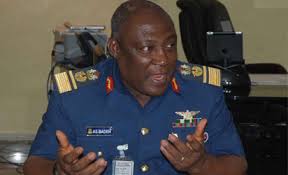
CDS warns politicians of inflammatory remarks, denies rift between Service Chiefs, Defence Minister
Chief of Defence Staff, Alex Badeh, has warned prominent Nigerians to stop making inflammatory remarks about the current security challenges facing the country.
According to him such statements were capable of undermining the morale of the armed forces and jeopardise military operations in the troubled spots.
The Defence Chief stated this in a memo he presented on Monday to the National Conference Committee on National Security headed by a former Inspector General of Police, Gambo Jimeta, on Monday through Assistant Director, Legal Services, Defence Headquarters, G.O. Anyalemechi.
In the memo, the service chief denied there was any friction between the service chiefs and the defence minister as being insinuated.
A member of the National Conference, Brigadier-General Mansur Dan-Ali (retd), had claimed in memorandum he submitted to the Conference’s Committee on National Security last week that the counter-terrorism measures adopted by the military had failed.
The conference member from Zamfara State, also stated there was friction between the Defence Minister and the nation’s Service Chiefs.
Air Marshal Barde in reaction to the retired general’s statement, said in the memo that the delegate’s claims had cast aspersion on the armed forces and the political leadership of the nation.
“This is regrettable, especially coming from a source that is in a better position to appreciate the complexity of asymmetric warfare.
“It is hoped that highly-placed individuals would refrain from making inflammatory statements that are likely to undermine morale in the armed forces of Nigeria and jeopardize ongoing military operations.” Barde saidan adding that the allegations of maladministration in the armed forces contained in Mr. Dan-Ali’s memo had far-reaching implications on the general administration of the forces and by extension, national security.
He noted that it was particularly worrisome because the retired general did not give specific examples to substantiate the allegations and that it was instructive to observe that the Armed Forces Act, the Harmonised Terms and Conditions of Service as well as other related internal regulations of the respective Services contain adequate provisions and guidelines on the general administration and discipline of the forces.
“The Nigerian Armed Forces have over the years endeavour to adhere strictly to these provisions. This accounts for the cohesion and unity of purpose that define the corporate existence of the Armed Forces of Nigeria. The perceived failure as alluded to in the memorandum by the author is capable of undermining the corporate existence of the country. This should not be allowed to happen.”
On the friction between the Defence Minister, he said, “This Headquarters dissociates itself from any imagined friction between the Honourable Minister of Defence, the Chief of Defence Staff and the Service Chiefs.
“The Armed Forces Act has clearly defined functions and assigned responsibilities with respect to the general administration of the Armed Forces. It also establishes Councils and Boards chaired by the Honourable Minister of Defence.”
Air Marshal Badeh explained that the total subordination of the military to civil authority was not an issue that should be belaboured.
He said the minister superintends over the ministry which encompasses the Armed Forces of Nigeria.
“Undoubtedly, the minister does not take part in actual military operations, and may not, in those circumstances, exercise operational command and control of troops. This does not in any way dilute the democratic imperative of civilian control of the military.”
The CDS also denied the delegate’s claim that the military no longer adheres to the Federal Character principle, insisting that it does especially at the point of entry.
He however said promotions were guided by clear provisions of the Harmonised Terms and Conditions of Service as amplified by individual regulations applicable to the Services.
He added, “General, promotion in the armed forces is a privilege and not a right. For a senior officer to be eligible for promotion, he must satisfy certain conditions. These include deployability, good confidential report, specified academic and professional qualifications as well as establishment vacancy, amongst others. These are adhered to as much as they are humanly possible.”